
Introduction
A research question can look deceptively simple. It may be only one sentence, yet almost every important decision that follows depends on it.
What literature should you read? What evidence should you collect? Who or what should you study? Which methods make sense? What kind of conclusion will you eventually be able to defend?
A weak question makes each of these decisions harder. A strong one gives the research direction.
That is why asking whether a question is interesting is not enough.
The more useful question is:
Is this a question worth pursuing as research?
A research topic is not yet a research question
Researchers often begin with a subject that interests them:
social media
online learning
employee motivation
climate change
academic performance
These are topics. They identify an area of interest, but they do not yet tell us what needs to be understood.
Even something that sounds more specific—
“Social media and academic performance among university students”
—is still largely a topic.
Research begins to take shape when we identify a relationship, uncertainty, process, experience, disagreement or problem that deserves investigation.
For example:
| Stage | Example |
| Topic | Social Media |
| Problem | We do not clearly understand how different patterns of social media use relate to students’ study behavior |
| Research question | How do different patterns of social media use relate to study behaviour among undergraduate students? |
The movement from topic → problem → question is important.
A good question does not simply tell us what the research is about. It tells us what the research is trying to understand.
1. A worthwhile question begins with a genuine problem
The word problem does not necessarily mean that something is wrong.
A research problem may be:
- an uncertainty,
- a contradiction,
- a poorly understood relationship,
- an unexplained observation,
- a gap between theory and practice,
- or a situation that existing knowledge does not adequately explain.
This matters because research should have a reason to exist.
Consider:
What is artificial intelligence?
That may be a perfectly reasonable question in a classroom, but by itself it is unlikely to constitute a useful research problem.
Compare it with:
How are postgraduate students using generative AI when preparing literature reviews, and what difficulties do they encounter when evaluating the reliability of AI-generated information?
Now there is something to investigate.
The second question points toward behaviour, experience, reliability and evidence.
Good research questions emerge from something we need to understand—not simply from something we can ask.
2. The question must be answerable with evidence
Some questions are important but cannot easily become empirical research questions.
For example:
Is technology making humanity better?
It is intellectually interesting, but several problems immediately appear.
What does better mean?
Which technology?
Which people?
Over what period?
What evidence could establish the answer?
Research requires us to move from an abstract concern toward something that evidence can actually illuminate.
That does not mean every question must become narrow or purely quantitative.
Questions about experiences, meanings, cultures, beliefs and interpretations can all be researched.
But the researcher should be able to answer a fundamental question:
What evidence could reasonably help me understand this?
If no plausible evidence can be identified, the research question probably needs more work.
3. It should be specific—but not artificially narrow
Beginning researchers are often told:
“Narrow your topic.”
That advice is useful, but it can also be misunderstood.
The objective is not to make a question as small as possible.
The objective is to make it clear enough to investigate meaningfully.
Compare:
How does social media affect students?
with:
How does social media use affect academic performance among students?
The second is narrower, but important ambiguities remain.
What counts as social media use?
Which students?
What does “affect” mean?
How is academic performance being measured?
And are we actually able to establish causation?
A stronger formulation might instead ask:
What relationship exists between patterns of social media use and self-reported study behaviour among undergraduate students at a particular university?
Notice what happened.
The question became clearer not merely because it became longer, but because important concepts became more precise.
Specificity should reduce ambiguity.
It should not make the question unnecessarily complicated.
4. The question should matter
A research question can be perfectly answerable and still contribute very little.
Suppose we ask:
What percentage of students prefer blue pens to black pens in one classroom?
That could be measured very easily.
But unless pen preference connects to some meaningful theoretical, educational, behavioural or practical issue, it is difficult to explain why the investigation matters.
A useful research question usually has significance in at least one of several ways.
It may improve our understanding of a phenomenon.
It may test or extend an existing explanation.
It may address a practical problem.
It may examine an understudied population or context.
It may challenge something that has been assumed rather than demonstrated.
It may provide evidence that helps people make better decisions.
This is where the literature becomes especially important.
The researcher needs to understand not only what has been studied, but also why another study would add something worth knowing.
5. The question should guide the methodology—not follow it
A surprisingly common mistake is to choose the method first.
A researcher decides:
“I want to conduct a survey.”
or:
“I will use interviews.”
or:
“I want to use regression.”
and then looks for a research question that fits the chosen technique.
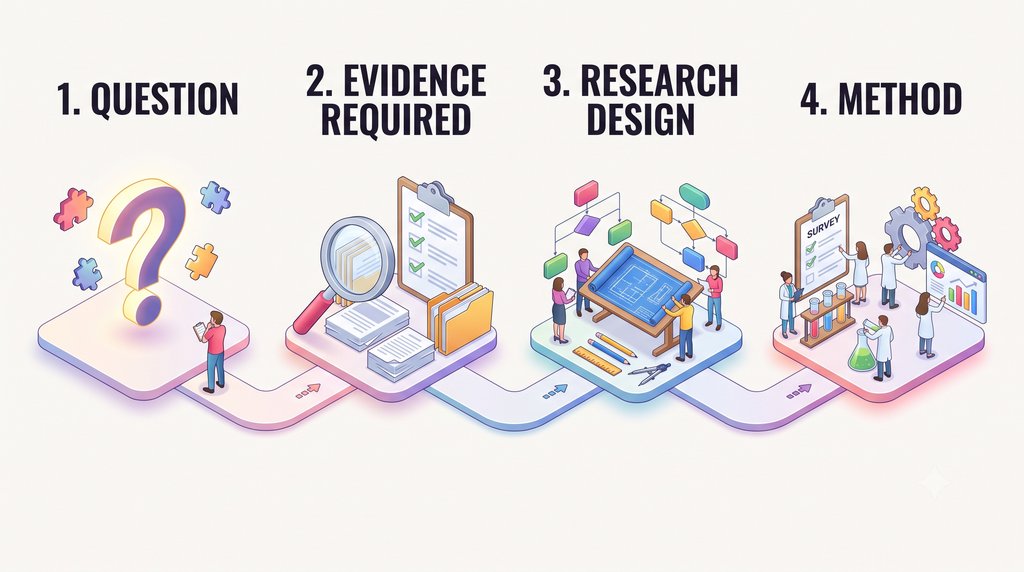
The logic should usually move in the opposite direction.
Question → evidence required → research design → method
Question
Evidence required
Research design
Method
If the question asks about measurable relationships between variables, a quantitative approach may be appropriate.
If the question asks how people interpret an experience, qualitative interviews might make more sense.
If it asks both how widespread something is and why people experience it in particular ways, a mixed-methods design might be justified.
Methodology is not decoration added after the research question.
It is part of the logic through which the question becomes answerable.
6. It must be feasible
Some research questions are excellent intellectually but impossible within the resources available to the researcher.
Imagine a postgraduate student proposing:
How does socioeconomic inequality affect educational outcomes across all developing countries?
The question is important.
But completing such a study convincingly may require enormous datasets, cross-national comparability, considerable methodological expertise and years of work.
Feasibility therefore matters.
A researcher should consider:
time, access, data, participants, skills, ethics and resources.
This does not mean choosing unambitious questions.
It means designing research that can actually be completed well.
A smaller study executed carefully is often more valuable than an enormous question investigated superficially.
7. The answer should not already be built into the question
Sometimes a question quietly contains the conclusion the researcher expects to find.
For example:
How does excessive social media use damage students’ academic performance?
The wording already assumes that the effect is damaging.
Compare:
What relationship exists between social media use and academic performance among undergraduate students?
The second formulation allows the evidence to determine the nature of the relationship.
Research should not merely produce evidence for a conclusion we have already decided to believe.
Good questions leave room for discovery.
One question can determine an entire research design
Consider the difference between these three questions:
Question A
How many postgraduate students use generative AI for academic work?
This primarily asks about prevalence.
Question B
How do postgraduate students use generative AI when conducting academic research?
Now we are interested in practices and behaviours.
Question C
How do postgraduate students judge whether information produced by generative AI is reliable enough to use in academic research?
Now the central issue is evaluation and judgment.
All three concern postgraduate students and generative AI.
But they are not the same study.
Each question changes:
the evidence we need,
the people we might speak to,
the data we collect,
the methods we choose,
and the conclusions we can legitimately make.
That is the power of the research question.
A useful test
If I answered this question convincingly, what would we understand that we do not understand clearly enough now?
Before committing to a research question, ask yourself:
If that question is difficult to answer, the research problem may still be unclear.
If the answer is meaningful, the next questions become easier:
Can I obtain appropriate evidence?
Can I investigate this ethically?
Can I complete the work with the time and resources available?
Does the question allow more than one possible outcome?
Will the methodology logically follow from what I am asking?
These questions are often more useful than trying to make a research question conform mechanically to a formula.
A good question does not need to sound impressive
Researchers sometimes make questions more complicated because academic language appears more sophisticated.
But complexity of language is not complexity of thought.
A research question should ideally be understandable to someone who knows the field without requiring them to decode the sentence first.
The intellectual depth should come from the problem being investigated—not from unnecessary terminology.
A clear question is not a simplistic question.
Often, clarity is evidence that the researcher has understood the problem sufficiently well to express it precisely.
The question will probably change
There is one final point that is easy to overlook.
Your first research question does not have to be your final research question.
Reading the literature may reveal that your assumptions were wrong.
Early interviews may expose dimensions of the problem you had not considered.
Available data may force you to reconsider what can actually be answered.
Concepts may become clearer.
A population may need to be narrowed.
This refinement is not evidence that the research has failed.
It is often evidence that the research process is working.
Research questions develop as understanding develops.
The important thing is that every revision makes the relationship between the problem, question, evidence and method more coherent.
The question is the beginning of the argument
A strong research question does not guarantee strong research.
But weak research questions create problems that good statistical software, sophisticated terminology and large amounts of data cannot repair later.
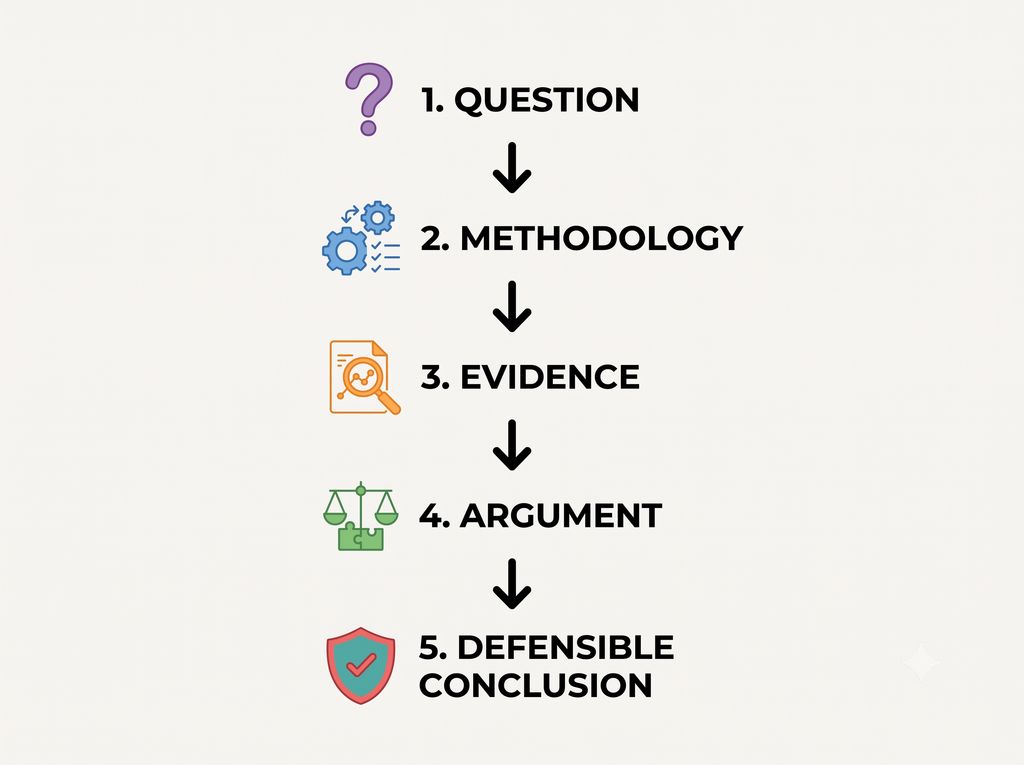
The question establishes what the research is trying to understand.
The methodology establishes how we will investigate it.
The evidence establishes what we can observe.
And the argument establishes what we are justified in concluding.
That chain begins with the question.
So before asking:
Which method should I use?
or
How much data do I need?
or
Which statistical test should I run?
there is an earlier question worth spending considerably more time on:
What, exactly, am I trying to understand—and is it worth investigating?
Good research questions emerge from something we need to understand—not simply from something we can ask.